

The Economics of Running Rotary Screw Air Compressors Australia: Cost, Maintenance & Lifecycle Value
 By ELGi |
  9 min read | 9 March, 2026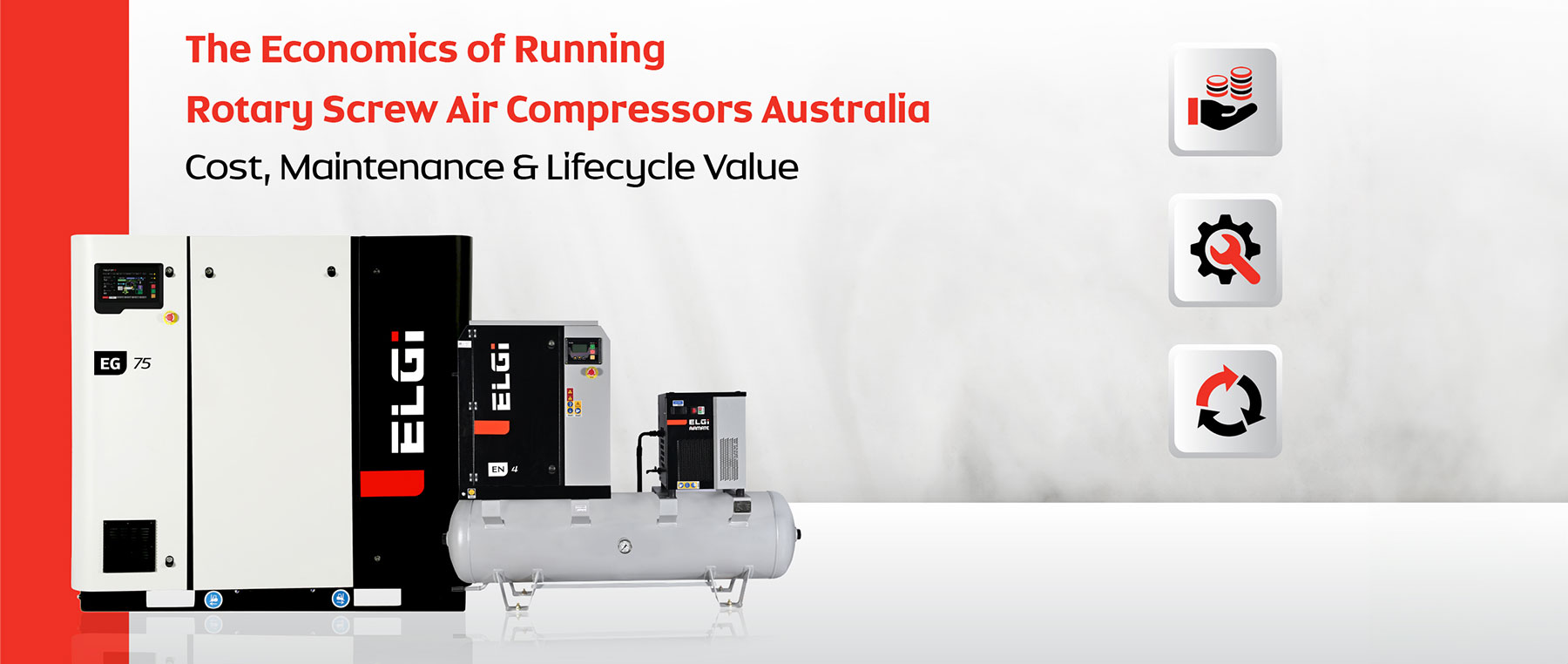
Introduction
Rotary Screw Air Compressors sit at the centre of many industrial operations because they deliver steady air, handle long duty cycles, and support production environments that rely on stable pressure and flow. Purchase price matters; then total cost of ownership decides the real outcome. Electricity, operating habits, service intervals, air quality requirements, and sizing accuracy determine whether an installation becomes a cost burden or a long-term advantage.
This blog explains upfront cost drivers, energy exposure, maintenance realities, and lifecycle value. It also includes practical questions that help engineering and procurement teams avoid expensive mismatches during upgrades and new builds.
Inflation, Energy Prices, and Why Compressor Economics Matter in 2026
In 2026, Rotary Screw Air Compressors sit under sharper cost scrutiny as energy volatility and uptime expectations rise across industrial operations. For facilities running multi-shift production, compressed air has become a controllable operating cost rather than a fixed utility expense.
Global industrial air compressor demand is projected to exceed USD 24 billion in 2026, driven by automation, manufacturing expansion, and efficiency mandates. However, the financial performance of Rotary Screw Air Compressors depends less on market growth and more on how efficiently systems convert electricity into usable air at the plant level.
Across Australia, wholesale electricity prices fluctuate across regions within the National Electricity Market. For plants operating high-duty Rotary Screw Air Compressors, even small variations in effective $/kWh materially change annual operating cost. Poor control logic, pressure setpoint drift, oversized capacity, and unmanaged leaks quietly multiply energy waste across thousands of operating hours.
Why Rotary Screw Air Compressors Stand Out in Industrial Duty Cycles
Rotary screw air compressors dominate industrial duty cycles because they sustain continuous demand with stable discharge pressure, minimal pulsation, and high mechanical reliability. This makes them the default choice for automation lines, process air systems, and continuous manufacturing environments.
Key attributes driving adoption of Rotary Screw Air Compressors in industrial service include:
In this blog, brought to you by ELGi Australia, you’ll learn:
- Continuous air delivery for extended operating hours
- Stable pressure profiles supporting precision equipment
- Lower vibration-induced wear under steady load conditions
- Scalable configurations for light, mid, and heavy industrial duty
- Compatibility with VSD controls, sequencers, and energy optimisation systems
The best rotary screw air compressor for a plant is defined by how closely its capacity profile matches real demand. Mismatch between compressor sizing and load profile remains one of the most common sources of long-term energy waste in industrial rotary screw air compressor installations.
Upfront Cost Considerations
Installed cost is rarely the unit price alone. A real comparison includes electrical works, piping, air treatment, commissioning, condensate management, and the control strategy that governs how the compressor loads, unloads, and idles.
Typical price drivers include:
- Capacity and motor power (kW / HP), and the site’s duty cycle expectation
- Fixed speed vs variable speed drive (VSD) based on load variability
- Air quality requirement : oil-flooded rotary screw compressor vs oil-less rotary screw compressor
- System scope : dryers, filters, receivers, drains, smart controllers, heat recovery
- Site conditions : intake temperature, dust load, ventilation, and room design
- Service access : parts logistics, service coverage, response windows, uptime support
A higher upfront invoice can still win on lifecycle cost if it reduces energy waste, protects critical production uptime, and avoids premature major service events
Total Cost of Ownership Over 10 Years
Many plants underestimate how strongly energy dominates lifecycle cost. Multiple industry references place energy as the largest ownership component over a compressor’s life, commonly 70 percent or more, depending on duty cycle and system efficiency.
Typical lifecycle cost distribution (planning view)
| Cost Category | What It Includes | What Usually Drives It |
|---|---|---|
| Initial purchase and install | Compressor, electricals, commissioning, piping tie-ins | Sizing accuracy, site readiness, integration scope |
| Energy | Electricity is used to generate compressed air | Load profile, leaks, pressure setpoints, control strategy |
| Routine service | Filters, lubricants, and scheduled inspections | Service intervals, operating hours, and environment |
| Repairs and parts | Wear items, valves, hoses, and major overhauls | Age, heat, contamination, and delayed maintenance |
| Air treatment | Dryer energy, filter replacements | Air quality requirement, moisture load, maintenance discipline |
Key takeaway : the best rotary screw air compressors for your site are the one that matches your demand profile with minimal waste, not the one with the lowest initial invoice.
A Practical Cost Example for an Australian Plant
Here is a simple, decision-stage way to think about energy exposure.
Assume a 75 kW rotary screw compressor running 4,000 hours per year (typical for many two-shift environments).
Annual energy use ≈ 75 kW × 4,000 h = 300,000 kWh
Now apply an electricity rate scenario. Wholesale electricity prices vary, and contracts differ, but even modest changes in effective $/kWh make a major difference at this consumption level. The AER’s wholesale price reporting illustrates that variability by region and quarter.
If your effective all-in rate moves by AUD 0.05 per kWh, the annual cost swing is:
300,000 × 0.05 = AUD 15,000 per year
That is why energy strategy (controls, leaks, pressure discipline, sizing) often delivers a faster payback than many mechanical upgrades.
Maintenance Costs and What to Expect
Maintenance is the second major lever after energy. It is also the difference between predictable uptime and expensive interruptions.
Common maintenance activities
- Intake air filter changes
- Oil and oil filter changes for oil-flooded rotary screw compressor systems
- Belt, coupling, and hose inspections
- Cooler cleaning in dusty or high-heat environments
- Condensate management and dryer checks
- Leak detection and pressure drop reviews
Oil-flooded vs oil-less servicing reality
- Oil-flooded rotary screw compressor systems often deliver strong durability and sealing efficiency when serviced on schedule.
- Oil-less rotary screw compressor systems reduce oil contamination risk and suit clean-air needs, but they can be more sensitive to filtration discipline and operating environment.
Your selection should be driven by air quality requirements, risk tolerance, and maintenance capability, not by a generic “oil-free is better” rule.
Energy Costs and Usage Patterns
Energy spend is shaped less by brand and more by how the system is run:
- Leaks : small leaks compound into a constant load
- Pressure setpoint creep : every unnecessary bar increases energy draw
- Idle running : fixed-speed units left loaded and unloaded waste power
- Wrong sizing : oversized compressors cycle inefficiently and create artificial demand
- Poor air treatment choices : dryer type and pressure drop add ongoing energy cost
For many sites, upgrading the control strategy and fixing leaks can reduce waste without changing the compressor.
Lifecycle Value, Service Life, and Resale Considerations
Well-managed Rotary Screw Air Compressors commonly achieve service lives exceeding a decade when duty cycles, intake conditions, and thermal loads remain controlled. Lifecycle value improves when system performance remains stable across expansion cycles and production changes.
Asset value retention improves when operators can demonstrate:
- Documented service history
- Stable operating hours and load profiles
- Controlled discharge temperatures
- Clean intake and cooling conditions
- Consistent air quality management
For operators evaluating Elgi rotary screw air compressor platforms, lifecycle value strengthens when equipment selection is paired with system audits, energy optimisation programs, and long-term service planning tied to operating reality rather than theoretical duty assumptions.
Ways to Lower Lifecycle Costs Without Cutting Corners
Lowering total ownership cost is usually about reducing waste and preventing avoidable failures:
- Match compressor control to demand : VSD is often the right choice where loads fluctuate, while stable baseloads may justify different configurations.
- Treat leak management as a routine : Leaks are a recurring operating tax.
- Stop pressure creep early : Keep setpoints disciplined and measure pressure drop across filters and dryers.
- Right-size the system, not just the compressor : Storage, piping, and air treatment selection often decide whether the compressor runs efficiently.
- Build a service rhythm around operating hours : Service plans built on real hours outperform calendar-only servicing.
Services That Protect Your Investment
Lifecycle economics stay predictable when equipment selection and service capability work together. ELGi supports industrial operators with rotary screw solutions built for light to heavy-duty use, backed by service structures that focus on uptime and long-run efficiency.
Typical support areas include:
- Installation and commissioning
- Scheduled maintenance programs aligned to operating hours
- Genuine spare parts planning
- Performance optimisation reviews and system audits
A procurement-grade conversation becomes easier when the supplier can provide a lifecycle cost view tied to duty cycle, energy exposure, and maintenance planning rather than a unit-only quotation.
Smart Buying Questions to Ask Before You Commit
Use these questions to reduce risk and avoid expensive mismatches:
- How much air do you need at base load vs peak load?
- What air quality class does your process require?
- What does downtime cost per hour in your plant?
- What is your current pressure profile and pressure drop across the system?
- Who owns maintenance execution, and how consistent is it?
- Can your supplier provide performance support beyond installation?
FAQs
How long do rotary screw air compressors usually last?
With proper servicing and clean intake conditions, Rotary Screw Air Compressors typically deliver 10 years or more of reliable service in industrial environments.
Why do energy costs dominate compressor lifecycle cost?
Compressed air generation is power-intensive. When Rotary Screw Air Compressors operate for long duty cycles, electricity becomes the largest cost driver over time.
Is an oil-less rotary screw compressor always the better option?
Oil-less systems excel where air purity is critical, but they are not automatically the lowest-cost option for every duty cycle. Air quality requirements and operating environment should decide the configuration.
Can I reduce operating costs after installation?
Yes. Leak control, pressure setpoint discipline, and better control strategies can significantly reduce waste in Rotary Screw Air Compressors after commissioning.
Final Thoughts
Rotary Screw Air Compressors deliver serious industrial value when treated as a long-term economic system rather than a one-time purchase. Upfront cost matters, then energy discipline, correct sizing, air treatment choices, and consistent servicing decide the real lifecycle outcome.
Across Australia’s industrial sector, the fastest wins usually come from system thinking: understand demand, stabilise control, remove waste, then align equipment and service planning to the operating reality. For teams considering Elgi rotary screw air compressors, a lifecycle cost assessment tied to operating hours, energy exposure, and air quality requirements is the most practical starting point.

The Benchmark for Performance: What Defines the Best Industrial Air Compressors in Australia Today
If the compressed air supply stopped for ten minutes on a production site, the impact woul...
7 min read 
Best Practices for Maintaining Oil-Flooded Screw Compressors in Australia’s changing climatic conditions
Australia’s industrial operations rely on compressed air systems that can perform consis...
1 min read 
Oil‑Injected Rotary Screw Air Compressors in Australia: Sizing, Energy & Maintenance
Compressed air systems often hide big costs and risks. In regions with hot, dry, and deman...
7 min read 
How to Evaluate Rotary Screw Air Compressor Manufacturers in Australia (Oil‑Injected)
Choosing the right oil injected rotary screw air compressor manufacturer in Australia can ...
6 min read 
Why is it Essential to Treat Wastewater?
The very subsistence of life depends on water - plants, anim...
4 min read 
How Waterford Crystal Modernized Tradition with ELGi’s EG Series Compressors
Waterford Crystal, a leader in luxury crystalware, partnered with ELGi to integrate EG Ser...
1 min read 
How ELGi’s EG Series Air Compressors are Revolutionizing Building Products Manufacturing in Australia
A premier Australian building products manufacturer has transformed their operational effi...
1 min read 
How Compressed Air Fuels Efficiency for the Automotive Industry
This case study explores how a leading fuel management syste...
1 min read 
How ELGi’s Compressors Are Powering Efficiency in the Garment Industry
This case study explores how ELGi’s air compressors are tr...
2 min read 
How ELGi’s EG Series Air Compressors are Empowering Precision Milling in Europe’s Composite Tooling Industry
This case study showcases how a leading composite tooling ma...
1 min read