

The Benchmark for Performance: What Defines the Best Industrial Air Compressors in Australia Today
 By ELGi |
  7 min read | 9 March, 2026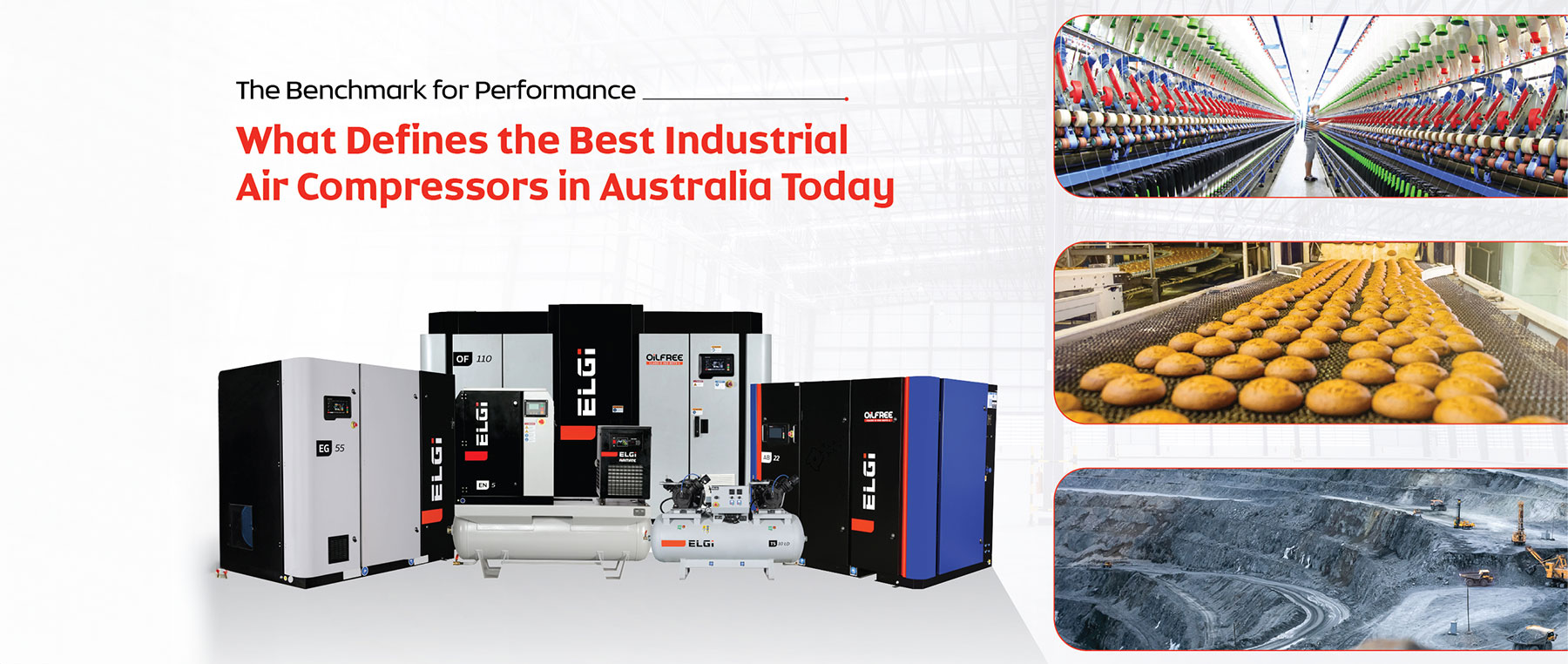
If the compressed air supply stopped for ten minutes on a production site, the impact would reach production throughput, product quality, and maintenance response cycles almost immediately. For most industrial operations, the industrial air compressor functions as a core utility alongside power and water.
As operating margins tighten and energy accountability increases, selecting the right industrial air compressor now carries long-term operational consequences. Performance expectations extend beyond rated capacity. Stability under load, predictable energy consumption, air quality control, and service continuity define long-term reliability across production environments.
This blog outlines how performance benchmarks are assessed across Australian industrial environments, and how technical teams evaluate compressed air systems based on measurable operating outcomes rather than nominal equipment specifications.
Why performance has become the primary evaluation metric
Maintenance engineers and plant managers evaluate compressors through operational behaviour rather than brochure claims. Performance assessment focuses on consistency under load, response during production fluctuations, and predictability of operating costs.
Performance indicators are typically assessed on-site
- Stable pressure delivery under variable load conditions
- Flow consistency when multiple demand points operate concurrently
- Moisture and oil control across distribution networks
- Controlled start-stop behaviour that protects mechanical assemblies
- Diagnostic visibility through control interfaces
- Field support response times aligned with uptime requirements
Energy consumption remains a central concern. According to the Australian Alliance for Energy Productivity, compressed air systems account for approximately 16 per cent of electricity usage in manufacturing facilities, with 80–90 percent of input energy typically dissipated as heat or system losses.
Selection of an industrial air compressor, therefore, directly influences long-term operating expenditure, grid load management, and sustainability reporting outcomes.
Compressor types used across Australian industrial sites
Industrial air compressor selection in Australia varies based on duty profile, production criticality, and site operating conditions. Engineering teams typically evaluate platform suitability alongside performance benchmarks to ensure alignment with actual demand behaviour.
Rotary screw compressors are commonly deployed in continuous-duty environments where stable pressure delivery and high uptime are required. Variable speed drive configurations support part-load efficiency in facilities with fluctuating production cycles.
Fixed-speed rotary screw platforms are applied where load profiles remain predictable, and sequencing strategies are used to manage base-load and trim demand across multiple compressors.
Reciprocating compressors continue to serve intermittent-duty applications, maintenance workshops, and low-duty production zones where duty cycles are short, and peak demand is localised rather than continuous.
Oil-free compressor systems are specified in sectors where air quality directly influences product integrity, including food processing, pharmaceuticals, electronics manufacturing, and clean production environments.
Aligning compressor platform type with duty behaviour reduces energy losses, minimises cycling stress, and improves long-term stability of the industrial air compressor system.
2025 market signals shaping selection criteria
Performance benchmarks now align with documented market patterns rather than anecdotal preference. Investment in compressed air infrastructure continues to rise as industrial sites prioritise energy control and asset longevity.
Key market indicators
Recent industry analysis reports that the regional air compressor market exceeded USD 300 million in 2024 and is projected to approach USD 460 million by 2033, driven by expansion in manufacturing, resources, and logistics sectors.
Global industrial compressor demand is projected to cross USD 22 billion in 2025, with steady growth projected across heavy manufacturing and process industries.
These patterns reflect a shift towards lifecycle-based equipment evaluation rather than short-term capital cost prioritisation, reinforcing performance-led selection frameworks for industrial air compressor investments.
Technical criteria applied by engineering teams
Procurement frameworks increasingly incorporate system-level evaluation rather than isolated machine selection. Typical review parameters include:
1. Duty profile analysis
- Operating hours per shift and annual utilisation
- Peak demand periods relative to base load
2. Pressure and flow control
- Minimum and maximum pressure thresholds across production zones
- Transient response under multi-line demand
3. Air quality management
- Oil-free or oil-lubricated configuration requirements
- Filtration stages aligned with end-use sensitivity
4. Environmental operating conditions
- Ambient temperature tolerance
- Particulate and moisture exposure risk
5. Electrical compatibility
- Grid capacity and start-up current constraints
- Load management capability
6. Lifecycle cost modelling
- Capital expenditure compared with the ten-year operating cost
- Service intervals, consumables, and spares availability
Applying these parameters early in specification development reduces mismatch risk between installed capacity and operational demand.
How do air compressor manufacturers in Australia differentiate on performance
Technical buyers increasingly compare suppliers based on empirical performance data, documented operating behaviour, and field reliability across Australian industrial operating conditions.
Common technical comparison points
- Load profile stability across operating ranges
- Variable speed performance at partial demand
- Noise attenuation in mixed-use production zones
- Energy metering resolution and reporting accuracy
- Service logistics coverage for metro and regional facilities
Performance signals observed among leading suppliers
- Publication of part-load efficiency curves under industrial duty cycles
- Documented lifecycle cost modelling across ten-year operating windows
- Equipment platforms aligned across stationary and portable air compressor products
- Validation under high ambient temperature and particulate-exposed operating environments
These parameters guide objective comparison of industrial air compressor offerings and support procurement decisions based on documented performance behaviour rather than nominal specification ratings.
Operational indicators of a correctly specified system
On-site experience remains a practical validation layer for performance benchmarks:
- Tool response remains consistent under concurrent demand
- Pressure variance across headers remains within tolerance
- Maintenance activity shifts towards scheduled inspection
- Moisture-related quality deviations decline
- Power demand remains predictable across production cycles
Industry guidance on compressed air system optimisation highlights that structured control, leak management, and thermal recovery contribute materially to operating stability and equipment service life.
ELGi Compressor technical positioning for industrial duty cycles
ELGi Compressor platforms are engineered for extended duty cycles, elevated ambient temperatures, and variable load profiles encountered across industrial sites. The product portfolio spans oil-lubricated and oil-free rotary screw systems, reciprocating units, and portable air compressor products developed on shared technical architecture.
Technical attributes applied at the system level
- High-ambient cooling architecture rated for elevated temperature operation
- In-house airend development optimised for output stability at controlled rotational speeds
- Moisture separation prior to downstream filtration stages
- Low oil carryover thresholds in lubricated platforms
- Integrated controller architecture supporting sequencing and remote monitoring
- Environmental protection options for exposed installations
- Compliance alignment with AS1210 pressure vessel requirements
- Maintenance access engineered for service interval management
These factors support consistent performance under extended operational cycles, particularly in heat and particulate-exposed settings.
System ecosystem for industrial applications
- Rotary screw, reciprocating, and portable units integrated under common service protocols
- Refrigerated drying and filtration for air quality management
- Application guidance across resources, food processing, textiles, packaging, and manufacturing
- Support for vessel registration and regulatory compliance planning
This systems-based approach supports predictable operation across entire compressed air networks rather than isolated equipment deployment.
Selection checklist for technical evaluation
Prior to approval of any industrial air compressor specification, technical teams typically apply structured evaluation checkpoints aligned with site operating behaviour:
- Confirm capacity alignment with peak operational demand across production zones
- Compare commercial air compressor for sale options using lifecycle cost modelling
- Review part-load performance curves and metered energy data
- Validate expansion headroom relative to projected throughput growth
- Confirm service coverage for metro and regional operations
- Model long-term power consumption, service intervals, and consumables expenditure
Clear documentation at this stage reduces exposure to performance variance, operating cost escalation, and post-installation correction within industrial air compressor networks.
Conclusion
Compressed air functions as industrial infrastructure rather than auxiliary equipment. Performance benchmarks now prioritise stability under load, controlled energy use, air quality management, and predictable service response across industrial environments.
Engineering-led evaluation of industrial air compressor systems supports long-term operational continuity, energy accountability, and controlled cost structures. Suppliers that publish transparent performance data, document part-load behaviour, and support lifecycle modelling contribute materially to informed asset selection decisions.
Technical teams assessing new installations or system upgrades can apply these benchmarks when reviewing available air compressor products, including platforms developed by ELGi Compressor, against site-specific duty profiles and operating conditions typical of Australian industrial environments.

The Economics of Running Rotary Screw Air Compressors Australia: Cost, Maintenance & Lifecycle Value
Introduction Rotary Screw Air Compressors sit at the centre of many industrial operations...
9 min read 
Best Practices for Maintaining Oil-Flooded Screw Compressors in Australia’s changing climatic conditions
Australia’s industrial operations rely on compressed air systems that can perform consis...
1 min read 
Oil‑Injected Rotary Screw Air Compressors in Australia: Sizing, Energy & Maintenance
Compressed air systems often hide big costs and risks. In regions with hot, dry, and deman...
7 min read 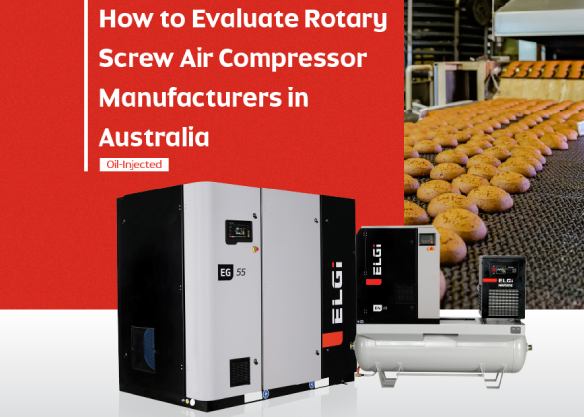
How to Evaluate Rotary Screw Air Compressor Manufacturers in Australia (Oil‑Injected)
Choosing the right oil injected rotary screw air compressor manufacturer in Australia can ...
6 min read 
Why is it Essential to Treat Wastewater?
The very subsistence of life depends on water - plants, anim...
4 min read 
How Waterford Crystal Modernized Tradition with ELGi’s EG Series Compressors
Waterford Crystal, a leader in luxury crystalware, partnered with ELGi to integrate EG Ser...
1 min read 
How ELGi’s EG Series Air Compressors are Revolutionizing Building Products Manufacturing in Australia
A premier Australian building products manufacturer has transformed their operational effi...
1 min read 
How Compressed Air Fuels Efficiency for the Automotive Industry
This case study explores how a leading fuel management syste...
1 min read 
How ELGi’s Compressors Are Powering Efficiency in the Garment Industry
This case study explores how ELGi’s air compressors are tr...
2 min read 
How ELGi’s EG Series Air Compressors are Empowering Precision Milling in Europe’s Composite Tooling Industry
This case study showcases how a leading composite tooling ma...
1 min read