

How to save energy in an air compressor plant with energy-saving cyclic refrigeration dryer?
 By ELGi |
  5 min read | 8 April, 2025
Need for dryer
When the atmospheric air comprising of moisture, particle contaminants, and oil gets compressed, the concentration of such particles and moisture increases by 6-10 times. Other contaminants like oil and traces of metal get added during the compression process with the air compressor.
When compressed air cools down, water vapour (Moisture) precipitates as condensate, which must be removed from the compressed air system. Drying compressed air is an important part of the air treatment process.
Let us understand the problems resulting from the presence of moisture in compressed air:
- Damages and causes malfunctioning of air-powered equipment and instruments
- Corrodes compressed air piping causing leakages and adding impurities to the air
- Results in the degradation of product quality and growth of microbiological contaminants where the air comes into direct contact with the end product, such as food, medicine, chemicals, etc.
A dryer reduces the moisture content, avoids condensation in piping, and hence is an ideal accessory that can be used for a wide range of applications.
According to the International Standard, ISO 8573-1:2010, compressed air contaminants like particles, water, and oil are segregated as per purity classes. In this standard, microorganisms and other gases are not included. As a result, the air purity is indicated as [P, W, O] and is ordered as per the number of particles, water, and oil.
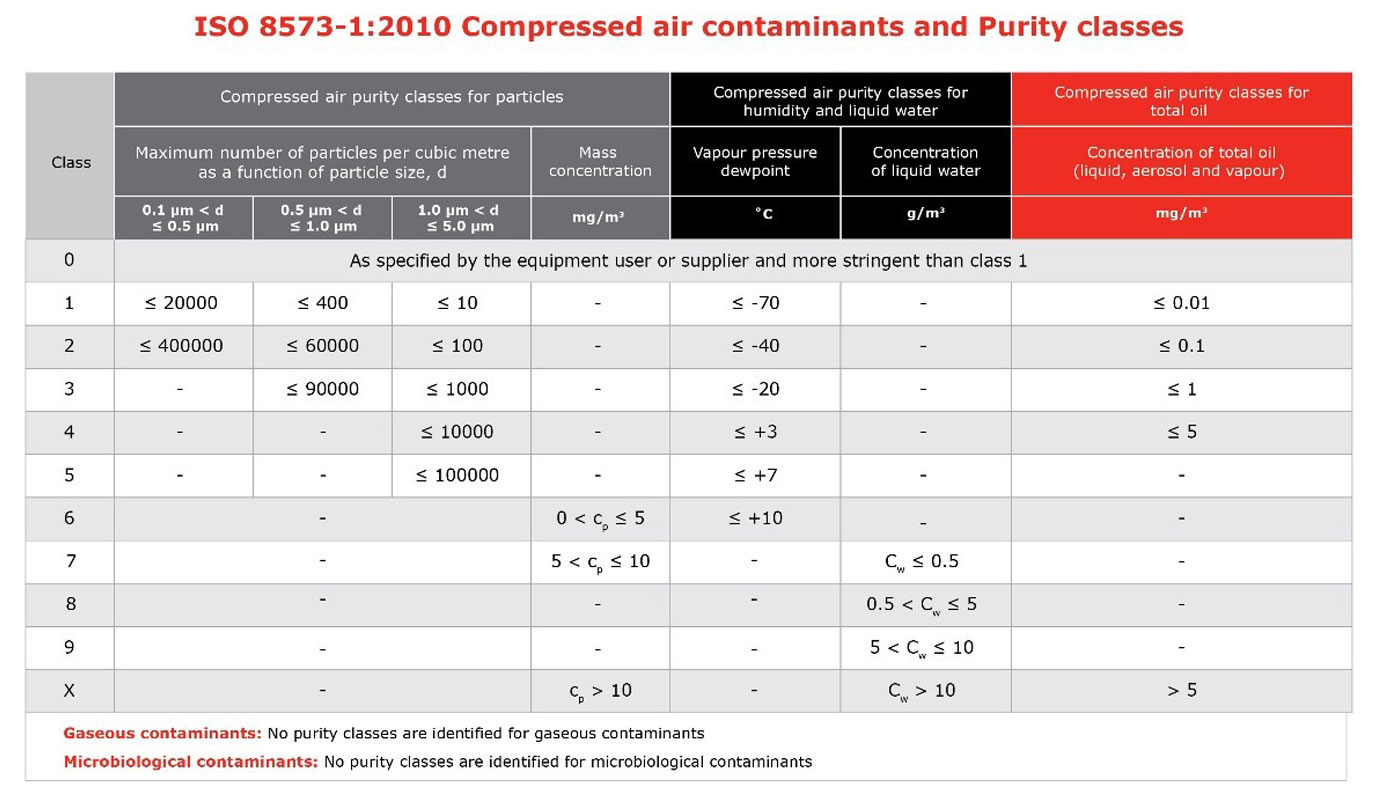
Based on the application requirement, water vapour is to be removed from the compressed air by using the suitable dryer.
- With a refrigeration air dryer, class 4,5,6 of water vapour can be achieved, i.e. ISO 8573-1:2010 [-: 4 :-]
- With a desiccant air dryer, class 1,2,3 of water vapour can be achieved, i.e. ISO 8573-1:2010 [-: 1 :-]
How to remove moisture?
The recommended sequence of installation for any type of dryer is shown below.
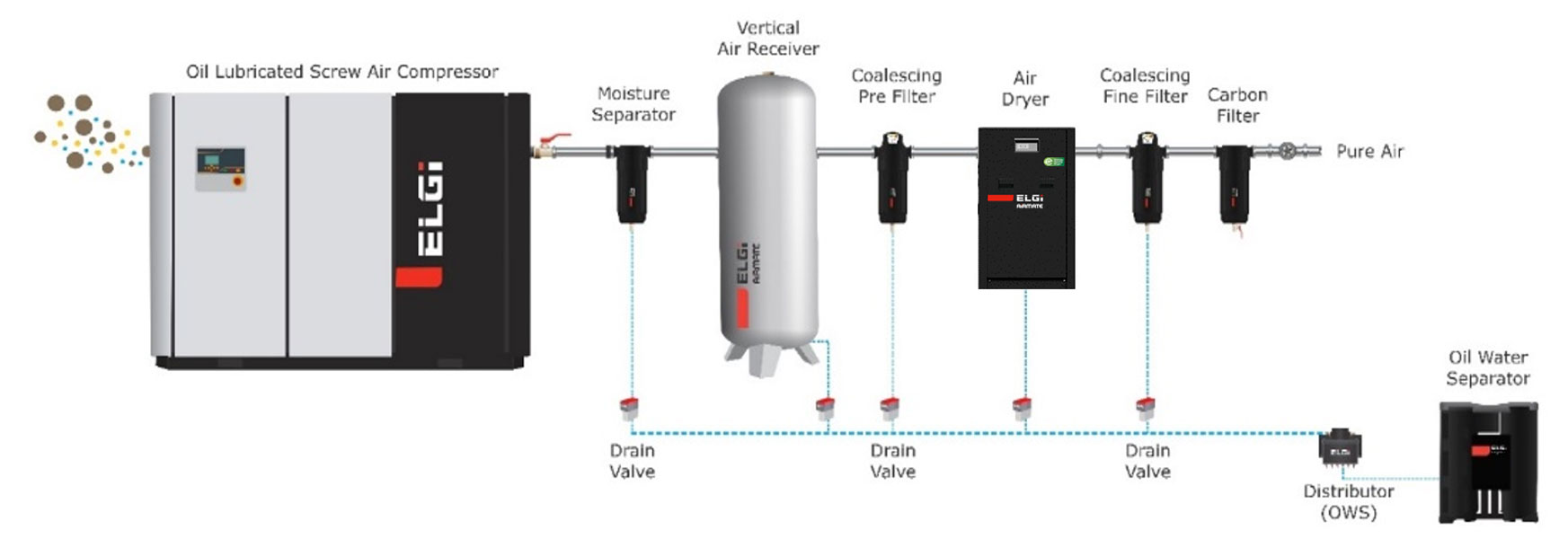
Moisture Separators help remove the bulk water from the compressed air. It is mandatory to have a proper automatic drain along with the moisture separator, as they are mostly used after the cooler. The optimal removal of condensate will ensure that no bulk water carries over to the downstream equipment. It is recommended to use a level-sensing zero-loss drain and a moisture separator to get this done with minimum loss of air.
The Wet Receiver (before the dryer) acts as a heat exchanger, cooling off the air and thus condensing bulk moisture before it reaches the dryer. The water can be drained from the bottom of the tank with a motorized timer drain. By removing some moisture in advance, the air receiver tank reduces the load on the air dryer. This is true for any dryer type, be it a Refrigerated air dryer or a desiccant dryer.
For your air quality requirement of class 4,5,6, you can choose the refrigerated dryer.
Refrigeration Dryers are further divided into two types
- Non-cyclic refrigerated dryer
- Energy-saving (Cyclic) refrigerated dryer
Non-cyclic refrigerated dryer
Non-cycling refrigerated air dryers have refrigeration compressors that start as soon as you turn the dryer on ― and don’t stop until you turn the dryer off, except in some exceptional conditions. They are less expensive than cycling dryers and are a good choice for applications where they will constantly run at full capacity.
However, they can experience problems during periods of low compressed air usage; there is a possibility of freezing which leads to ice formation. To avoid this, Non-cycling refrigerated dryers are equipped with hot gas bypass valve, which sends the heat that the refrigeration compressor would normally discharge to the atmosphere back to the cold side of the system to keep it from freezing, thereby keeping the system stable and operating continuously.
Cyclic Dryer – Saves energy
The energy-saving cyclic dryer comes into the picture when there is no load or partial load. Unlike the non-cyclic refrigerated dryer, the cyclic dryer will go to ECO mode and switches off, thereby saving a lot of energy.
The energy-saving dryer can aid in reducing power consumption in situations such as
- During Winters/Night conditions, when the temperature of the cooling medium (air or water) is usually lower than in rated condition, resulting in a variation of the inlet/ambient air temperature to the dryer and reducing the load on the dryer
- When used with a VFD compressor & operating at lower flow, the dryer would regulate its capacity based on the flow load
- During compressor unloads, the dryer would also go to ECO mode and save energy
Non-cyclic refrigerated dryer vs cyclic refrigerated dryer
| Parts of a Non-cyclic dryer | Parts of a Cyclic dryer |
| Ref. compressor | Ref. compressor |
| Condenser | Condenser |
| Aluminium Heat Exchanger (Air –refrigerant) | Aluminium Heat Exchanger (Air-Glycol) |
| Electronic Controller | SS Heat Exchanger (Glycol –refrigerant) |
| Timer drain / Zero loss drain | Glycol tank |
| Pump for Glycol | |
| Electronic Controller | |
| Pre & fine filter | |
| Zero loss drain |
The advantage of ELGi’s Airmate Refrigerated Premium dryer (Energy Saving Cyclic Refrigerated Dryer) is that it saves energy by using the energy saving circuit; this circuit stores the energy required for cooling during the regular operation and uses it in ECO Mode for drying the air in partial load operations to maintain the desired dew point. While in ECO mode, the dryer, compressor, and fan motors are switched off to achieve energy savings.
The below graph represents the savings in winter at various loads for ES cyclic ref. dryer w.r.t Non-cyclic ref. dryer. Representation of 15°C delta temperature between summer and winter/night conditions
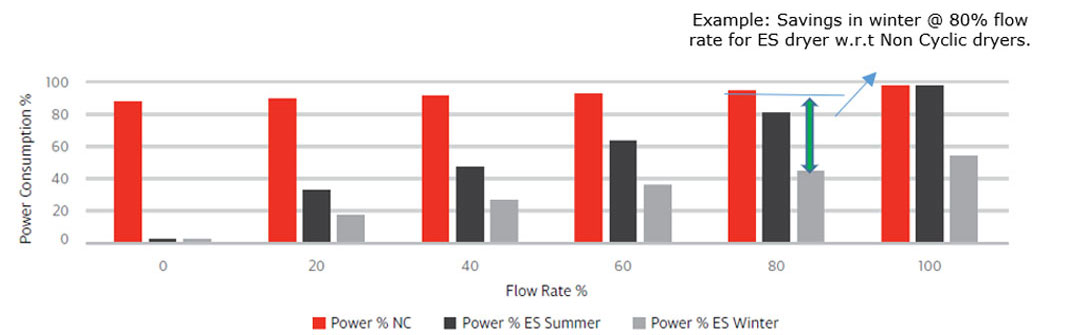
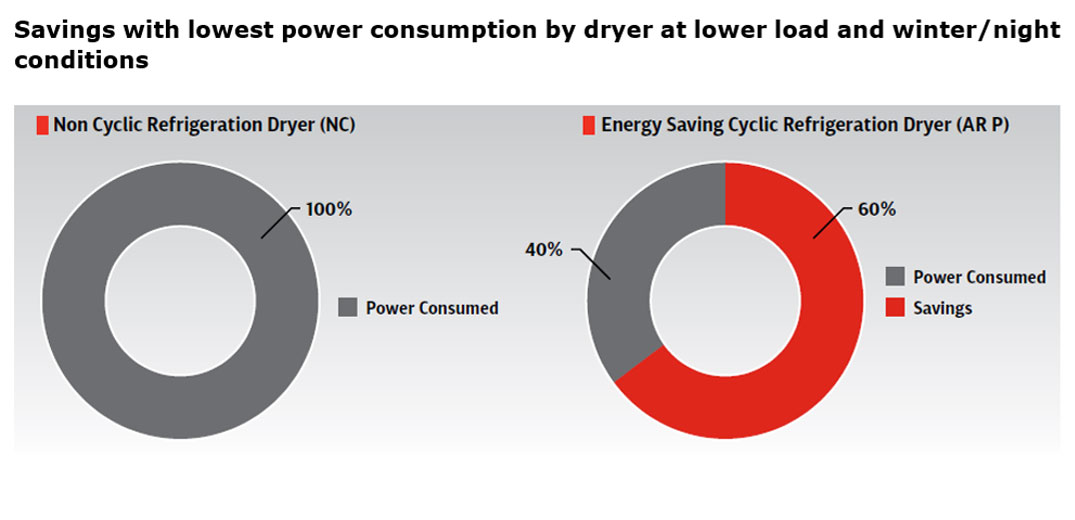
Energy savings of up to 60% with AR Premium refrigerated dryers*.
* Based on the dryer selected and its operating conditions
Conditions for the above illustration -
Dryer selected: AR 2990P for flow rate 1600 cfm at an ambient temperature of 40°C, an inlet temperature of 50°C, and 7 bar operating pressure.
Winter/Night conditions are ambient temperature of 20°C, inlet temperature of 30°C; 30% of the overall yearly operating hours.
6000 operating hours per year with 25% time at 100% load, 40% time at 75% load, 25% time at 50% load & 10% time at 25% load.
Similar topics
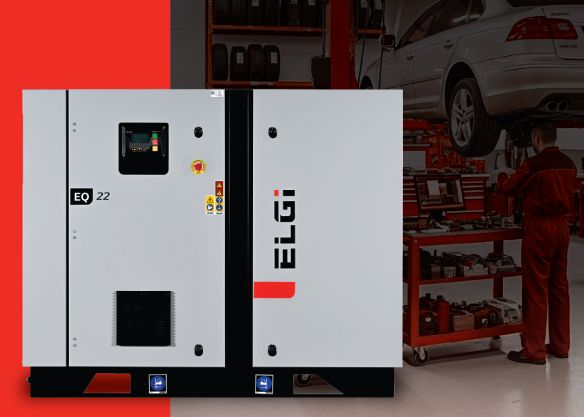
The Right Air Compressor Setup for Workshops, Tools & Repair Stations
Ever had a workshop day where tools suddenly feel off? The impact wrench hits softer. Th...
8 min read 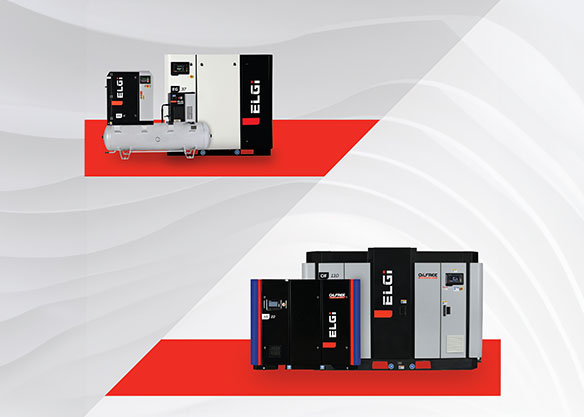
Oil-Injected vs Oil-Free Screw Air Compressor – How to Choose for Industrial Loads
When a plant runs three shifts, compressed air quietly controls how smoothly production ...
8 min read 
5 Technical Parameters To Compare Between Leading Screw Compressor Manufacturers
Choosing the right screw air compressor can often feel like stepping into a candy store ...
8 min read 
Screw Air Compressor vs Piston Compressor: Which Setup Fits Continuous Duty Cycles?
What happens when your production floor needs compressed air that never stops flowing? ...
7 min read 
Reciprocating Compressors: Working Principles, Components & Use Cases
A practical guide to reciprocating compressors, explaining how they work, their key comp...
9 min read 
Air Compressor Troubleshooting: A Comprehensive Guide to Rapid Problem Resolution
In modern industrial operations, compressed air systems function as critical utilities t...
8 min read 
A Maintenance Manager’s Guide to Making the Right Compressor Decision
When one call sets your uptime, spend, and risk profile Every maintenance leader meet...
2 min read 
The Efficiency Paradox and Customer Expectations in Compressed Air: Not Only a “Pressure” Matter
About the whitepaper In many industrial facilities, increasing operating pressure is se...
3 min read 
Direct Expansion Refrigerated Dryers: Preventing Costly Downtime with Proven Moisture Control Technology
Maximising efficiency and reliability in compressed air applications by converting untre...
8 min read 
Exploring Water-Injected Screw Technology for Reliable Oil-Free Compressed Air
Oil-free compressed air is central to quality and safety across pharma, food, beverage, an...
2 min read