

Oil-Free or Oil-Lubricated Screw Compressors: A Guide to Choose the Right Technology for Your Application
 By ELGi |
  3 min read | 19 May, 2025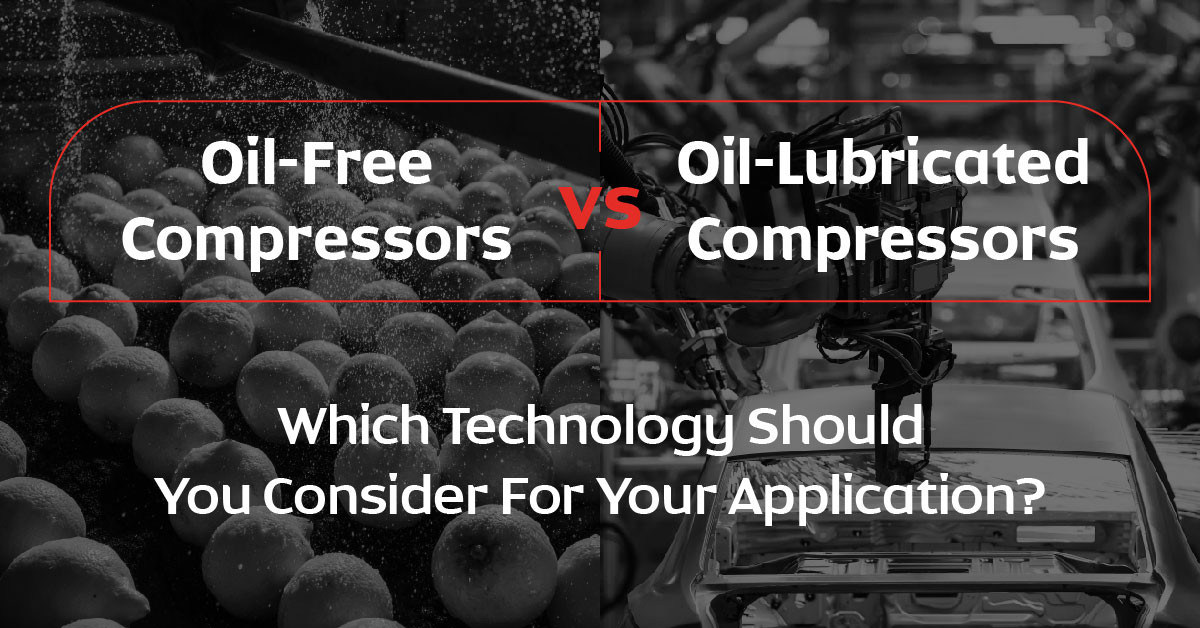
With today’s broad air compressor offering, many end users are asking themselves if they should choose an oil-free or oil-lubricated screw air compressor. While there may be local industry guidelines for the oil content in the compressed air, such as in the Pharma or Food & Beverage industry, there is no simple answer to the question of whether to go for an oil-free or an oil-lubricated screw compressor since every application comes with different requirements.
At ELGi, we have created this guide to facilitate your decision. There are three main criteria to look at when considering oil-free or oil-lubricated air compressors:
- Air Quality
- Reduction in Maintenance Requirements
- Noise
Air Quality Required for your Application
One of the most important criteria for choosing the right air compressor technology for your application with the same nominal power and same outlet delivery (flow rate, pressure, temperature) is the compressed air quality. This is governed by Air Quality Standard ISO 8573-1, measuring the size and amount of contaminants, such as oil, dust, and water, in the compressed air.
Under ISO 8573-1 there are seven additional sub-classes of air quality. Depending on the application, mostly Class 2 air quality or lower is chosen due to the large traces of oil content in the air in Class 3 and above. In more sensitive applications where the oil content in the air needs to be closely monitored, there is the choice between Class 1 and Class 0, Class 0 being the best possible air quality. For a general overview, the below choices would be recommended per industry.
| Class 0 | Class 1 |
|---|---|
| Food & Beverage | Metallurgy |
| Pharma | Pulp & Paper |
| Electronics, Production of semiconductors | General Manufacturing |
| Automotive Spray Painting | Energy Production |
| Textile Manufacturing |
Reduction in Maintenance Costs
Comparing the two different technologies with each other, an oil-free screw air compressor’s purchase price would be higher compared to an oil-lubricated screw air compressor. However, the oil-free technology comes with a reduction in maintenance requirements and costs as oil is only required for the lubrication of parts within the compressor and not for the lubrication of the airend.
Noise of Screw Air Compressors
Finally, there is the noise. Due to the dry technology, oil-free screw compressors would have a slightly higher noise level compared to oil-lubricated screw air compressors. Depending on the location of the compressor in the factory, the noise level can be an important criterion when choosing the right air compressor for your application.
So, what technology to choose now?
In summary, it is difficult to say one technology is better than the other, as it always depends on the application. For example, a general manufacturing business that is running its screw compressor 24/7 and requires only ISO 8573-1 Class 1 compressed air and runs its compressor close to its employees should opt for an oil-lubricated screw air compressor with filtration to protect its compressed air system from contaminants. A pasta manufacturer needing highly pure air according to ISO8573-1 Class 0 and wanting to reduce its maintenance costs should on the other hand opt for an oil-free screw air compressor.
Still not sure what technology to choose?
Contact our ELGi compressed air expertsSimilar topics
The Right Air Compressor Setup for Workshops, Tools & Repair Stations
Ever had a workshop day where tools suddenly feel off? The impact wrench hits softer. Th...
8 min read 
Oil-Injected vs Oil-Free Screw Air Compressor – How to Choose for Industrial Loads
When a plant runs three shifts, compressed air quietly controls how smoothly production ...
8 min read 
5 Technical Parameters To Compare Between Leading Screw Compressor Manufacturers
Choosing the right screw air compressor can often feel like stepping into a candy store ...
8 min read 
Screw Air Compressor vs Piston Compressor: Which Setup Fits Continuous Duty Cycles?
What happens when your production floor needs compressed air that never stops flowing? ...
7 min read 
Reciprocating Compressors: Working Principles, Components & Use Cases
A practical guide to reciprocating compressors, explaining how they work, their key comp...
9 min read 
Air Compressor Troubleshooting: A Comprehensive Guide to Rapid Problem Resolution
In modern industrial operations, compressed air systems function as critical utilities t...
8 min read 
A Maintenance Manager’s Guide to Making the Right Compressor Decision
When one call sets your uptime, spend, and risk profile Every maintenance leader meet...
2 min read 
The Efficiency Paradox and Customer Expectations in Compressed Air: Not Only a “Pressure” Matter
About the whitepaper In many industrial facilities, increasing operating pressure is se...
3 min read 
Direct Expansion Refrigerated Dryers: Preventing Costly Downtime with Proven Moisture Control Technology
Maximising efficiency and reliability in compressed air applications by converting untre...
8 min read 
Exploring Water-Injected Screw Technology for Reliable Oil-Free Compressed Air
Oil-free compressed air is central to quality and safety across pharma, food, beverage, an...
2 min read