

Choosing the Right Air Compressor for the Automotive Industry: Factors to Consider
 By ELGi |
  6 min read | 19 May, 2025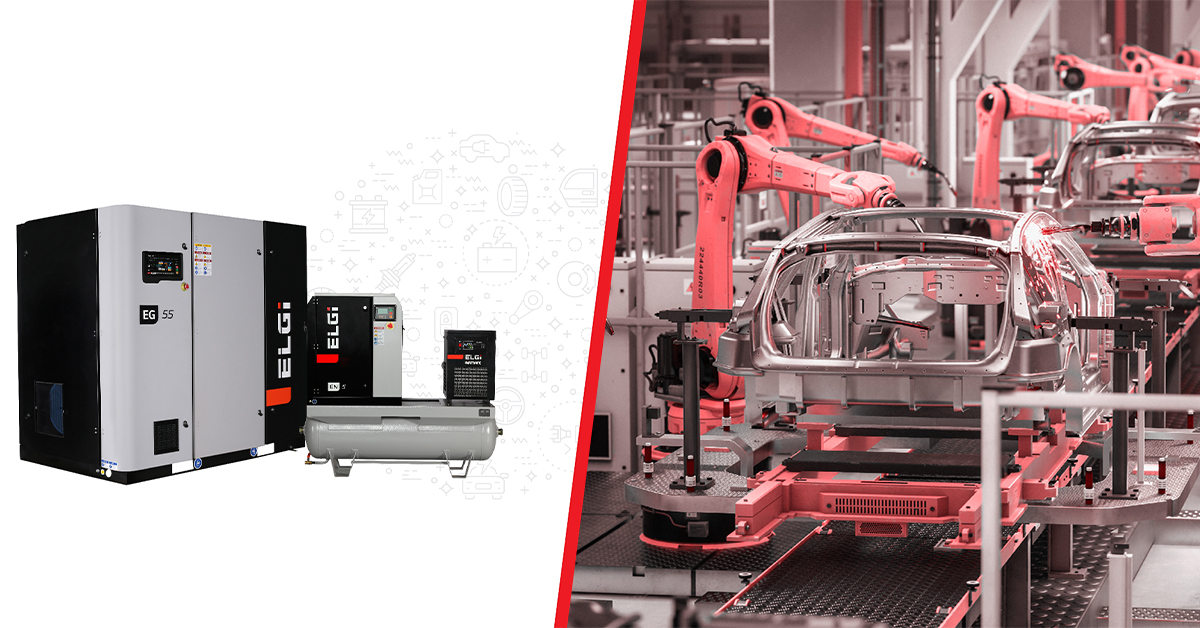
Over the past decade, there has been a notable surge in the global automotive manufacturing sector, driven by escalating demand day by day. As businesses continue to multiply, production and assembly lines are under significant strain due to the rising demand for automobiles, fuelled by increasing urban lifestyles. This has led to an increase in the suppliers to the automobile sector, one of which being the air compressor manufacturers.
Air compressors are essential tools that power a wide range of applications in the automobile sector, and choosing air compressors of the right motor type, air pressure, size, and design as per the application can boost manufacturing capabilities as well as save costs.
Specific to the automobile industry, ELGi has a wide range of compressors for automobile manufacturers that are highly dependent on automated robotic processes. Air compressors are key to supplying compressed air to various equipment involved in production and assembly lines, to servicing and maintenance of finished products.
The type and size of the air compressor required can vary as per plant or workshop. The volume and air pressure required to operate specific tools and equipment helps in choosing air compressors for industry use.
The Use of Air Compressors in Automotive Industry
In the automotive industry air compressors are used for a multitude of processes involved in various applications. ELGi, is one of the topmost industrial air compressor manufacturers in Europe comprising both screw air compressors and reciprocating compressors to meet the diverse needs of different operations. ELGi as an air compressor manufacturer plays a critical role in maintaining the efficiency, precision, and reliability required with air compressors in automotive manufacturing.
Some key applications in the automotive industry are-
1. Operation of pneumatic tools for various operations like welding, machining, and drilling using impact wrenches, grinders, pneumatic hammers, etc.
2. Air-operated robots used for welding, lifting, and precise part placement require compressed air.
3. Spray painting and coating are done using ELGi rotary-type compressors that power paint sprays that ensure smooth, even, and clear painting and coating.
4. Tyre Inflation, in case of adjusting tyre pressure to recommended levels, or for repair and maintenance.
5. Pneumatic material handling wherein hoists and conveyors use compressed air to transport parts and assemble them across the shop floor.
6. Cleaning and dust removal are done using high-pressure compressed air using air blow guns.
7. Air filtration systems are used in spray booths and paint preparation spaces that need to be free from dust and other contaminants.
Air compressor applications can be even more than listed here. However, it is important to know the factors that need to be considered for choosing the right air compressor as per the specific need of the operation in automotive manufacturing. Choosing the right air compressor manufacturer is crucial for efficient operations, as prompt service can save valuable time.
A few observations can help you in better decision-making before you look at the key factors can be as follows-
1. A comprehensive review of the historical power consumption to identify trends, peak usage periods, and potential areas for optimisation.
2. Check the load on pneumatic systems which includes assessing the demand for compressed air across various operations.
3. Count the number of equipment that need compressed air to figure out the overall demand and capacity required.
4. Keep in mind the future plans for the right long-term planning and investment.
While simple observations provide inputs into airflow and pressure requirements, optimising the use of industrial compressors in the automotive industry involves a more comprehensive approach.
Key Factors to Consider while choosing Air Compressors for Automotive Industry
Air Pressure Requirement
Different tasks require different pressure levels. For instance, pneumatic tools require 5-8 bar g of air pressure. Usually reciprocating air compressors are used for such applications. While oil-free rotary screw type air compressors are used in paint shops that have a low air pressure requirement that should be continuous and at a consistent pressure level. Tyre inflation requires a pressure of 10 bar g or above usually catered by reciprocating air compressors.
Air Volume/ Air Flow
In the automotive industry, some tasks need low airflow whereas some need high airflow. Tasks such as vehicle body cleaning and tyre inflation typically have lower airflow requirements, usually around 0.1 m3/min. Whereas, heavy-duty jobs like sanding and painting demand higher airflow volumes, often exceeding 0.6 m3/min or even higher depending on the scale and intensity of the work.
Duration of Use
The use of a compressor and its capacity can be decided depending on whether it is for intermittent use or continuous use. For short-duration tasks like tyre inflation or light-duty pneumatic tool operation, a portable small electric compressor or an ELGi reciprocating(piston) compressor is more suitable for intermittent use. Whereas, for a continuous compressed air supply for heavy-duty applications ELGi screw compressors are the best choice.
Air Compressor Types
Two main options are given by air compressor manufacturers for the automotive industry: reciprocating compressors for low airflow and intermittent use, while rotary screw compressors handle high-speed airflow continuously. Furthermore, as per the process requirement, the use of oil lubricated air compressors or oil-free air compressors is determined. In scenarios like vehicle assembly or spray painting requiring clean air, oil free screw compressors are employed. Whereas, for tasks like pneumatic tool operation or tyre inflation where oil particles cause no issue, oil-lubricated compressors are used.
Power Source
Consider whether you need an electric-powered or diesel-powered compressor. For use at a single place preferably indoors electric powered air compressors are used, whereas for use outdoors where portability is of high importance diesel powered air compressors are used for remote work sites.
Size and Portability
Determine the space available for the compressor to be installed and whether portability is required for the automotive tasks and processes.
Maintenance Requirement
Consider the maintenance needs of the compressor, including oil changes, filter replacements, and general upkeep. Choose ELGi for reliable support and service.
Budget
Determine your budget constraints and balance them with the required specifications and quality standards.
To conclude, while there is a wide range of compressors of different sizes, types, capacities, and designs, choosing the right compressor unit depends on the existing operations in the automotive plant and also keeping in mind the plans for expansion in the future.
ELGi is a world-class air compressor manufacturer having a range of compressor units providing air compressor solutions suitable for automotive manufacturers worldwide. ELGi air compressors combine the benefits of high efficiency, low downtime, low maintenance, and high reliability, while also being environment-friendly.
Similar topics
The Right Air Compressor Setup for Workshops, Tools & Repair Stations
Ever had a workshop day where tools suddenly feel off? The impact wrench hits softer. Th...
8 min read 
Oil-Injected vs Oil-Free Screw Air Compressor – How to Choose for Industrial Loads
When a plant runs three shifts, compressed air quietly controls how smoothly production ...
8 min read 
5 Technical Parameters To Compare Between Leading Screw Compressor Manufacturers
Choosing the right screw air compressor can often feel like stepping into a candy store ...
8 min read 
Screw Air Compressor vs Piston Compressor: Which Setup Fits Continuous Duty Cycles?
What happens when your production floor needs compressed air that never stops flowing? ...
7 min read 
Reciprocating Compressors: Working Principles, Components & Use Cases
A practical guide to reciprocating compressors, explaining how they work, their key comp...
9 min read 
Air Compressor Troubleshooting: A Comprehensive Guide to Rapid Problem Resolution
In modern industrial operations, compressed air systems function as critical utilities t...
8 min read 
A Maintenance Manager’s Guide to Making the Right Compressor Decision
When one call sets your uptime, spend, and risk profile Every maintenance leader meet...
2 min read 
The Efficiency Paradox and Customer Expectations in Compressed Air: Not Only a “Pressure” Matter
About the whitepaper In many industrial facilities, increasing operating pressure is se...
3 min read 
Direct Expansion Refrigerated Dryers: Preventing Costly Downtime with Proven Moisture Control Technology
Maximising efficiency and reliability in compressed air applications by converting untre...
8 min read 
Exploring Water-Injected Screw Technology for Reliable Oil-Free Compressed Air
Oil-free compressed air is central to quality and safety across pharma, food, beverage, an...
2 min read